Showing posts with label smartphone. Show all posts

6 Jul 2018

0 comments

Journeys


I'm thinking a lot about journeys and movement from, to and through at the moment. This is in part because I'm off to Iceland in September to take part in a group residency and I am reading lots about it, considering my role as an outsider coming in, why we travel, the idea of a place versus the reality, and all sorts of related things. It's also always a part of my week in this city where any journey takes an hour, where my studio is six miles from my home, where my friends are far flung (although drawing closer), where I have three roles and no permanent spot for any of them. 

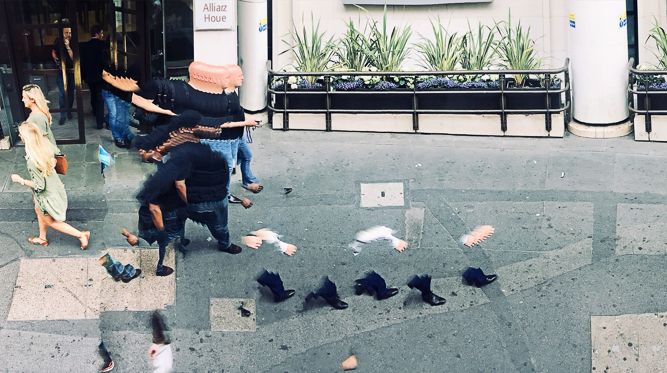
Last week I made some of these lovely glitchey panoramas that are helping me look at time. It's a technique I've tried before, whether shared here or elsewhere. They are a quick offshoot of something still else that's bubbling in the back of my hard drive. Who knows whether it'll ever come to fruition? It's not about the destination after all...

Oh, and it's also about manipulating the side of a bus into something I think terribly pretty.


3 Jan 2018

0 comments

A couple of ways of looking at a journey


It is Boxing Day. My mum is driving us to her house from family in Oxford. Outside, it is more or less sleeting. Inside, I am more or less asleep with my eyes open. Lights swing by, arcing and parting in sodium-tinted shades of mustard, mint, ultraviolet, scarlet; some woman on the radio selects bossanova tracks, smooth songs crackling as we pass through high hills that disrupt the signal. In an hour or two I will be in that middle bedroom with its magic, mystic properties of bestowing upon all its guests the best rest. For now we carry on along this somatic tube of road, tarmac thrumming to keep us on the edge of wakefulness.

Another way of looking is to listen. Click the image below or here to hear.


5 Dec 2017

0 comments

Collapsing time and other photographic tricks


Several months ago I posted about some 'tintypes' I'd been making. This project continues to chug away quietly in the background - I'm finding that only specific sorts of faces work for these portraits, so I am only shooting them when I come across someone who gives me that 'Aha!' sensation. Writer Catherine O'Shea's china-doll colouring somehow works perfectly even in black and white, while artist Ella Hempsted's Pre-Raphaelite hair gives the ideal frame for her face - I'll share these another time when the project feels like it's coming to some kind of fruition. 

Part of the reason I like making these fauxtypes is because of the way they collapse time - smashing past and present together and carrying it forward into the future. My latest subject is interested in the same thing, adding another layer to the images again. 


I'd been following Jordan J. Lloyd's Dynamichrome project online for ages; vintage images are digitally recoloured in astonishing detail, bringing the past vibrantly to life. As a fan, I attended the exhibition that launched the book The Paper Time Machine, created with Wolfgang Wild of Retronaut. Imagine my surprise when, describing the event to my studiomate, she revealed that he was a childhood friend. I jumped at the chance to add Jordan's 'tintype' to the gallery and we met at the Barbican. This itself is a total layer cake of history and I couldn't resist bringing the 'real' camera along to try and capture some of those surfaces - medieval, Brutalist, contemporary - too. Check out the Dynamichrome project online or on Instagram and buy the book! (This video is so worth watching for the jawdropping skills displayed).


24 Apr 2017

1 comments

Morocco, part IV: a multimedia adventure

The final post on my recent trip! I’d like to share some half-finished thoughts and some sketchy experimental bits and pieces.

As I’ve previously mentioned, Morocco blew my mind in the best way. This wonderful stimulation only added to the generally fresh and new creative vibes I’ve been feeling lately; exploring painting, drawing, writing, sketching ideas for multimedia pieces, film and performance art. 

Another piece of a jigsaw fell into place when I watched Randall Wright’s documentary about David Hockney shortly before leaving. Having visited Tate’s retrospective in February I was surprised how little I knew of Hockney’s output and how much I loved the work. (Run to see the exhibition, which closes soon!) and I was inspired to find out more. 

I watched the film on BBC iPlayer, where it’s no longer available, but you can watch the trailer online or buy the DVD and I strongly recommend that you do! One of the most interesting parts was where the artist was talking about making panoramas on his iPhone - how he thinks of them, like his multi-canvas landscapes or his collaged photographs as a way of exploring space differently and more expansively. 

Sometimes when I travel alone I take pictures of my own feet in the places I walk. (Also used this tired old trope as documentary while I’m training for a marathon hike to raise money for breast cancer research). Partly this stems from an impulse to prove I was there; partly I am embarrassed about asking strangers to take photos of me and am certainly not that interested in snapping selfies - mostly because I don’t look good, not because I hate selfies. This time just those photos didn’t seem to take in enough of the scene so I began to make vertical panoramas - I’m sure partly influenced by Hockney’s stamp of approval for this accessible form of photography. 


These turned into a way of documenting literal and emotional waystations. They also functioned to capture something of the landscape and required me to move within space to fill in the edges, to crane into a backbend to capture the blue sky and hot sun that was an intrinsic part of the experience for me. I’ve collected them below; they are kind of fun, and kind of silly, and kind of nothingy; but I also think they are interesting and in future travels I want to make more. 
Here are another couple made more 'traditionally' by rotating horizontally on the spot (one is shot by a fellow surfer and I think it’s kind of fascinating how a tiny, handheld object with almost zero photographic manipulability can create an image with such a sense of drama and scale. 

A final pano shows some glitched portions that I made by forcing the ‘stitching’ mechanism, moving the phone side to side more extremely than the instructions given by my phone were telling me to.
All of these were originally cropped and edited using phone and web apps (mostly Pixlr and the in-phone options) and this also provokes me into questioning the role of automation and control in my image-making. This is something I’ve been interested in for a while now and continue to experiment with. 

Before I even left I knew I wanted to try and recreate some of Hockney’s collaged photo-print works as these are some of my favourites of his; at the exhibition I particularly noted the piece Walking in the Zen Garden at the Ryoanji Temple, Kyoto for its inclusion of his feet pacing along the bottom edge. Thinking more carefully about digital creation, control and release of control, I ran the selection of images I shot at Le Jardin Majorelle through all of Photoshop’s ‘photo merge’ command; five are stitched together below. I want to consider the algorithms involved here; what is ‘looking’ at these images and what is being ‘decided’? Of course the automation isn’t ‘pure’; I edited the initial JPEGs; I chose the five to feature here, I was asked to select various options; I cropped them into squares and erased one errant image that almost none of the commands could incorporate (hence the gappy portion top left). I enjoy their slight - or not so slight - variations.

Also while at the Jardin Majorelle and pondering these things as I and all the other tourists wandered around documenting ourselves in this moment, I recalled that my camera has a built in double exposure mode and had a little play with that. Again, the camera decides various things then I - and Adobe’s little spiders - decide some more - but time folds briefly in on itself here, like the snap shut of the aperture itself. 
Here’s an accidental creation that happened while I was editing all my more traditional images of the Jardin - zooming as close as possible to check the crop on one picture, I realised I’d filled my screen with the International Klein Blue the house is famous for and in doing so created a Moroccan tile pattern of sorts. This has another layer too, seeing as (according to William Gibson, via Wikipedia), it is extremely difficult to reproduce accurately on computer screens…
AND FINALLY…another habit of mine when travelling or moving through my home city is to record sound clips of especially evocative moments. Among other things, I’ve recorded babbling rivers in Wales, vibrating hive sculptures in Kew Gardens, and a busking cellist under the U-Bahn in Berlin. All of these have an ability to transport me to a particular point and place in the way that scent does and that photographs rarely do. In Morocco, the calls to prayer that punctuate the day are one of those soundscapes, as are the sheer levels of birdsound (songs, twitterings, squawks). Click on the image below, which I shot before I recorded this clip, or here to visit the rooftop of my Marrakech riad as the sun sets.

With all of these noodlings, what I’m trying to do is stretch my practice a bit, to challenge my assumptions and habits and to begin finding a more expansive way of photographing.

15 Mar 2017

0 comments

You're just my (tin) type...what I've been up to lately


In the last month or two I've been making a bit of time each day to play with more personal work.


Very slowly I feel like I'm inching towards having something to say about this brilliant and infuriating thing we do with (or sometimes without!) cameras. Sometimes that means putting down my computer or my phone or my sweet little Olympus or my giant Canon lenses and picking up a brush, pair of scissors, and some glue to make collages, or a tin of watercolour blocks to do some painting

At night and on the train as I travel to and from the studio I'm swallowing books in a way that I haven't done for years; reading about the history of citrus farming in Italy, a novel about three African American sisters, a book about witchcraft, short stories about aliens coming to earth. 

I've seen some fantastic exhibitions and some very dull ones, pushing me to agree or disagree with outlook and method, to bring the cream of the matter to the top of the pint of opinion milk. I'm starting to learn to look in new ways, to think more broadly, to be open to unexpected connections and random occurrences. 


None of this is meant as a boast or a showy display of how ARTY I am, but rather to just say how lucky I feel for these days when I have space and time to explore in this way, and as a very lengthy intro to the photos you see in this post. 


Several years ago I took a workshop at Tate Modern, based around the work of Alighiero Boetti. I was drawn to his use of rules, his multidisciplinary practice, his playing off of the tension between order and disorder, chaos and control. Perhaps most importantly (for me, anyway) the results were absolutely beautiful artefacts. 

More recently I've been thinking about the interaction between digital and analogue technologies, about nostalgia, viscerality, craft versus art. This is manifesting in using apps to glitch photos and destroy images at a pixel level and conversely in a renewed love of PVA glue, papercraft and bookbinding.

I've written on this blog before about the magic of early photographic processes like tintypes or daguerrotypes when I documented gallerist Laura Noble's experience at the Unseen Photo Fair in Amsterdam. In the last week or two I've been experimenting with using apps to recreate this effect. Some are the pictures you see above. How crazy is it to look so far backwards with such forward facing tech? Do we feel cheated because the process can be approximated at the touch of a button? What does it mean when I print them out, stick with shiny tape, rescan, pin on my wall as I have done here?

I don't have any answers yet and I'm not even certain of the questions I'm asking. All I know is I'm having a tremendous time trying to find out. On Friday I'm excited to introduce some workshop students to the magic of cyanotypes (sun willing!). We will also be snapping away on our smartphones and I'm really interested to see what they make of these two activities. Keeping my eyes open is the name of the game...

A few more experiments, with my ever patient studio mates:


Turns out I've been intrigued by these old processes for a while...when rummaging for paper to mount my latest snaps I uncovered this clipping from an Observer magazine I cut out about a million years ago. How alive does this man look? He could be someone you passed in the street this evening.


Other photographers are using these techniques to brilliant effect. One of Joni Sternbach's tintypes of surfers could be seen at this year's Taylor Wessing Prize exhibition(but this one of mer-people is my favourite).